
Graham Stock, Senior EMD Sovereign Strategist, discusses the strong electoral showing for President Javier Milei in Argentina’s recent mid-terms, four notable aspects of the results, and the investment implications.
Key takeaways
Argentina has weathered a volatile and ground-breaking mid-term election season, culminating in a strong showing for President Javier Milei’s Liberty Advances (LLA) party on 26th October.
The election will be remembered as a major victory for Milei’s political movement and a key milestone on the challenging path to debt sustainability in Argentina.
We retain a constructive view on Argentina’s hard currency sovereign bonds and are encouraged by signs that improved governability will translate into further consolidation of the Milei administration’s agenda for fiscal adjustment and economic liberalization.
Argentina’s mid-terms were always likely to mark a pivotal moment for the Milei administration, determining its ability to sustain reform momentum in the second half of his term. A weak showing for Milei’s party and allies would have signalled waning public support for his fiscally conservative agenda and heightened concerns over the durability of policy implementation – likely negative for risk assets. Shifting expectations for success or failure drove large market swings in the month and a half running up to polling day, with bond prices moving 10 points in either direction several times and the currency trading in a 10% range (Chart 1).
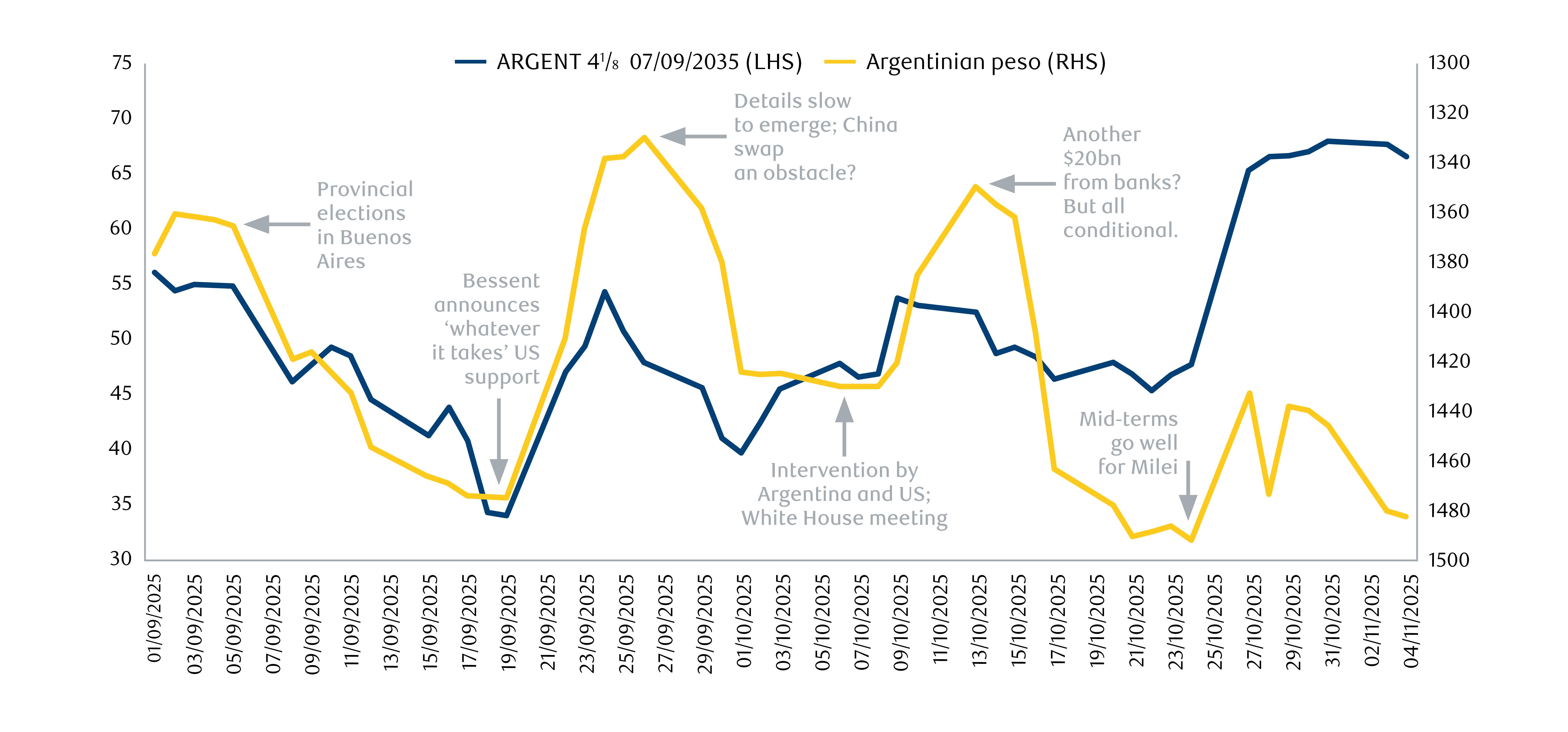
Opinion polls suggested a modest decline in support for Milei since the middle of the year but the main data point contributing to a reassessment of the administration’s prospects in the October mid-terms was a poor result in local elections held in the Province of Buenos Aires on 7th September. On that occasion, candidates for local government posts from the LLA party and its local coalition partners from the Republican Proposal Party (PRO), the party of former president Mauricio Macri, lagged the Peronist candidates by 13% pts.
The market’s knee-jerk interpretation of that outcome was to extrapolate to the national mid-terms and conclude that Milei would suffer a similar defeat, condemning him to a lame-duck second half of his mandate and opening the prospect of a return to power of the Peronists in late 2027, possibly even under the leadership of the hardline governor of the Province, Aires, Axel Kicillof, who was the main beneficiary of the local election.
To counter this narrative and tamp down its most obvious market manifestation – selling of Argentine pesos and bonds – the Milei administration reached out to the US government for support. In late September, US Treasury Secretary Scott Bessent announced a USD20 billion swap line with Argentina’s central bank to bolster dollar liquidity and stabilize the peso1. The rhetorical support was equally full-throated, with Bessent promising “whatever it takes”, in an echo of Mario Draghi’s commitment to the euro in 2012.
The US Treasury even put its money where its mouth was, so to speak, selling around USD2 billion to buy Argentine pesos and loudly publicizing the fact. This was followed by a further US promise in early October of a USD20 billion debt facility2, coordinated through a mix of sovereign funds and the private sector to help backstop Argentine sovereign issuance. This effectively doubled total US-led support to USD40 billion.
Each grand statement of support had a shorter half-life, however, as the election approached, and the US side kept details deliberately vague. A White House meeting between Presidents Milei and Trump and their teams should have been the crowning glory but was undermined when the US side explicitly linked continued financial assistance to the outcome of Argentina’s October mid-terms and Milei’s political mandate to hold the line on pro-reform (and US-friendly) policies.
“Given that Milei’s popularity had held up reasonably well, apparently because reducing inflation and tackling Argentina’s chronic fiscal deficit was increasingly recognized as a necessary policy step.”
We always expected Milei’s coalition to gain additional seats in Congress compared with prior elections, maintaining roughly one-third of the national vote. Half of the seats in the Lower House were at stake, and when they were last contested in 2021, Milei’s LLA party was in its infancy. One-third of the seats in the Senate were up for grabs and they were last contested in 2019 when his party did not exist at all. Given that Milei’s popularity had held up reasonably well, apparently because reducing inflation and tackling Argentina’s chronic fiscal deficit was increasingly recognised as a necessary policy step, winning more seats than it lost should have been within his party’s reach.
In the event, 27th October will be remembered as a major victory for Milei’s political movement and a key milestone on the challenging path to debt sustainability in Argentina. There were four notable aspects to the results:
Aggregating the national vote, LLA won the support of 41% of voters compared to just 32% for the Peronist party and its regional affiliates3.
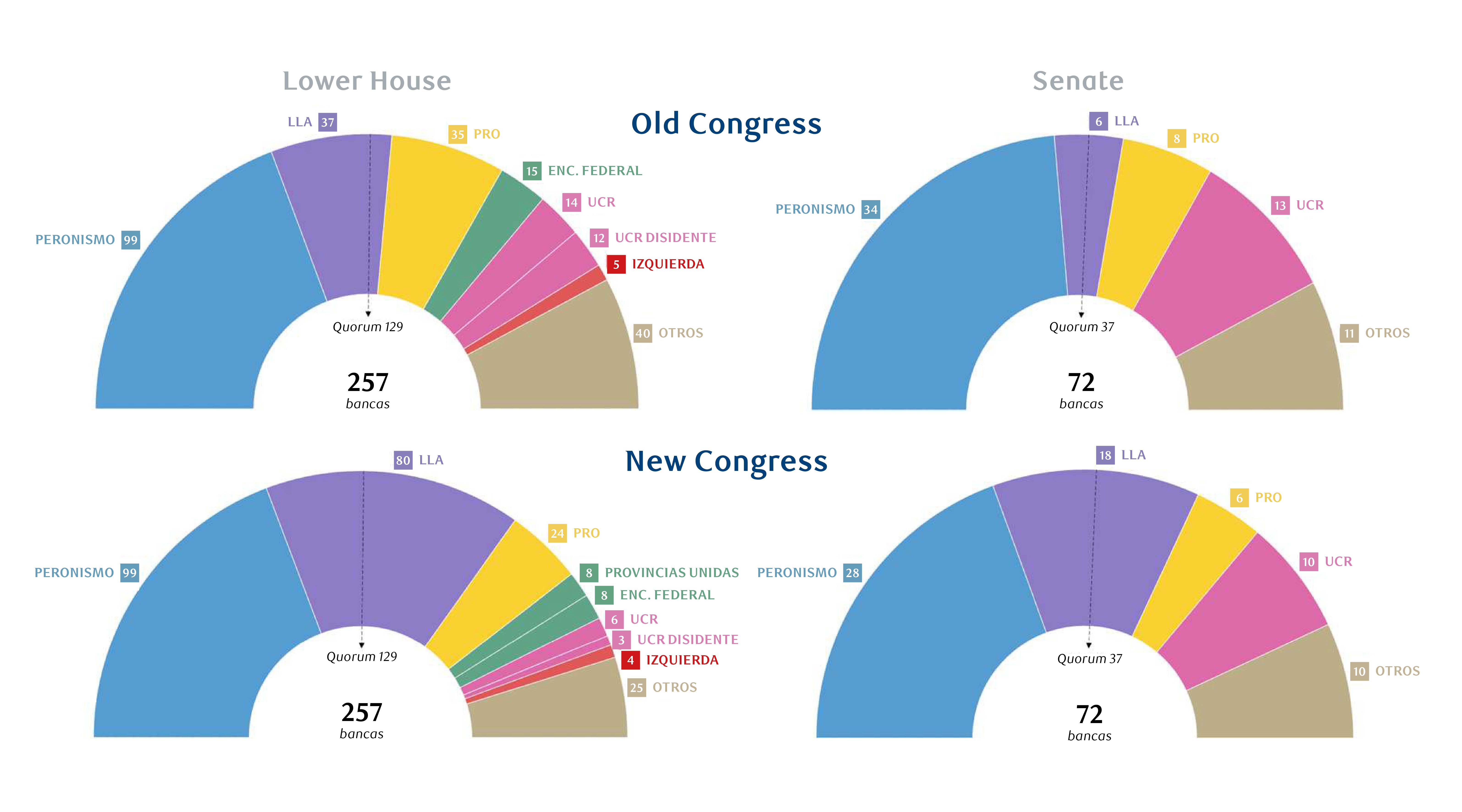
LLA boosted its share of both houses (Chart 2). It doesn’t have an absolute majority but can build one with the support of other smaller parties in the center. Importantly, the administration should comfortably engineer the one-third of the vote share needed to prevent presidential vetoes from being overturned. This is a key tool to defeat populist initiatives that can originate in either house.
The success of candidates from LLA and regional parties ended the combined leftist/Peronist majority in the Senate held since the restoration of democracy in 1983.
A striking improvement in LLA’s performance in the PBA turned a 13%pt in the local elections in September to a +0.6%pt margin of victory there in the national elections at the end of October. We attribute this to the reduced engagement of the powerful Peronist mayors, as well as a shift in focus from voters away from delivering a protest vote to the Milei administration and towards granting grudging endorsement of its policies. The happy side effects included reviving LLA’s image as a winner in Argentina’s dominant province in terms of population and economic activity, as well as undermining Governor Kicillof’s claims to be the next great hope for Peronist electoral strategy.
Chart 2: The alignment with the US has appeared to pay off for Milei
The government’s reaction to its unexpectedly strong electoral showing was arguably as important as the result itself. President Milei’s flamboyant and sometimes erratic style polarizes public opinion but also alienates other political actors, particularly when he is raging against la casta – his anti-elitist version of Trump’s ‘swamp’ metaphor for Washington politics. Instead, his victory speech was humble (relatively) and conciliatory.
He reached out to centrists and moderates, inviting them to co-operate in extending the wins of his first two years in office. He invited provincial governors to a meeting that took place the following Thursday, from which only the most implacable opponents were excluded. This is the improvement in governability that the Trump administration and the markets wanted to see coming out of the mid-term elections.
There are still plenty of pitfalls ahead. The provincial governors and centrist parties will extract a price for their support in Congress, but Milei now has additional political capital that can be deployed to keep the fiscal cost down. The sanctity of the balanced budget provision that underpins both the fight against inflation and the medium-term sustainability of Argentina’s debt dynamics can be preserved.
The pending economic policy challenge is to engineer an improvement in the balance of payments that allows for the accumulation of international reserves. Exports will continue to be supported by the expansion of agricultural activity and the oil/gas sector around Vaca Muerta, but the real appreciation of the peso since the 2023 devaluation has stimulated imports and discouraged inward tourism flows. In any case, the harvest is not due for another six months, and the current account only adjusts slowly.
The big prize is a turnaround in the capital account of the balance of payments. The stickiest, most reliable type of capital inflow would be foreign direct investment into the sectors where Argentina has a clear comparative advantage – oil/gas, agribusiness and mining (for copper, lithium, and potentially rare earths). Investment decisions in these sectors take a long time and rely on confidence in the long-term business environment. If LLA had suffered a debilitating defeat in the mid-terms, no amount of special investment regimes or incentives would have offset the fear of a Kirchnerista return in 2027. Now, the government has a chance to make the case that Argentina has changed for the better and will be pushing hard for US firms, in particular, to invest as part of a geopolitical realignment away from China.
In the shorter term, and partly dependent on confidence that the long-term outlook is brighter, portfolio flows offer the only realistic prospect for capital account inflows. The monetary authorities hope that the stock of dollars accumulated by local households and corporates as a hedge against an adverse election result, can now be tempted back into local currency through a combination of attractive interest rates and the improved policy outlook. Better levels at which to sell those dollars might also help if consistent with the broader policy framework.
Market access for the sovereign is also an increasingly realistic prospect as yields on sovereign bonds head down towards 10%. Initial support might still be needed from the north of the hemisphere, maybe in backing for a mooted debt-for-education swap or in an explicit commitment to help with 2026 amortisation payments (to bring the risk premium down further). However, the prospect is certainly looking much more feasible now than it did when bond prices were swooning at the prospect of a government defeat on 26th October.
In light of the above, we retain a constructive view on Argentina’s hard currency sovereign bonds. We are encouraged by signs that the improved governability will translate into further consolidation of the Milei administration’s agenda for fiscal adjustment and economic liberalisation. We always need to be watchful for potential setbacks, and the picture remains challenging, but the clouds have cleared for now as the Argentine summer approaches.
US ready to support Argentina with $20 billion swap line, Bessent says | Reuters.
US buys more Argentine pesos, working on $20 billion debt facility, Bessent says | Reuters.
Argentina’s Javier Milei hails ‘historic’ win in pivotal elections.